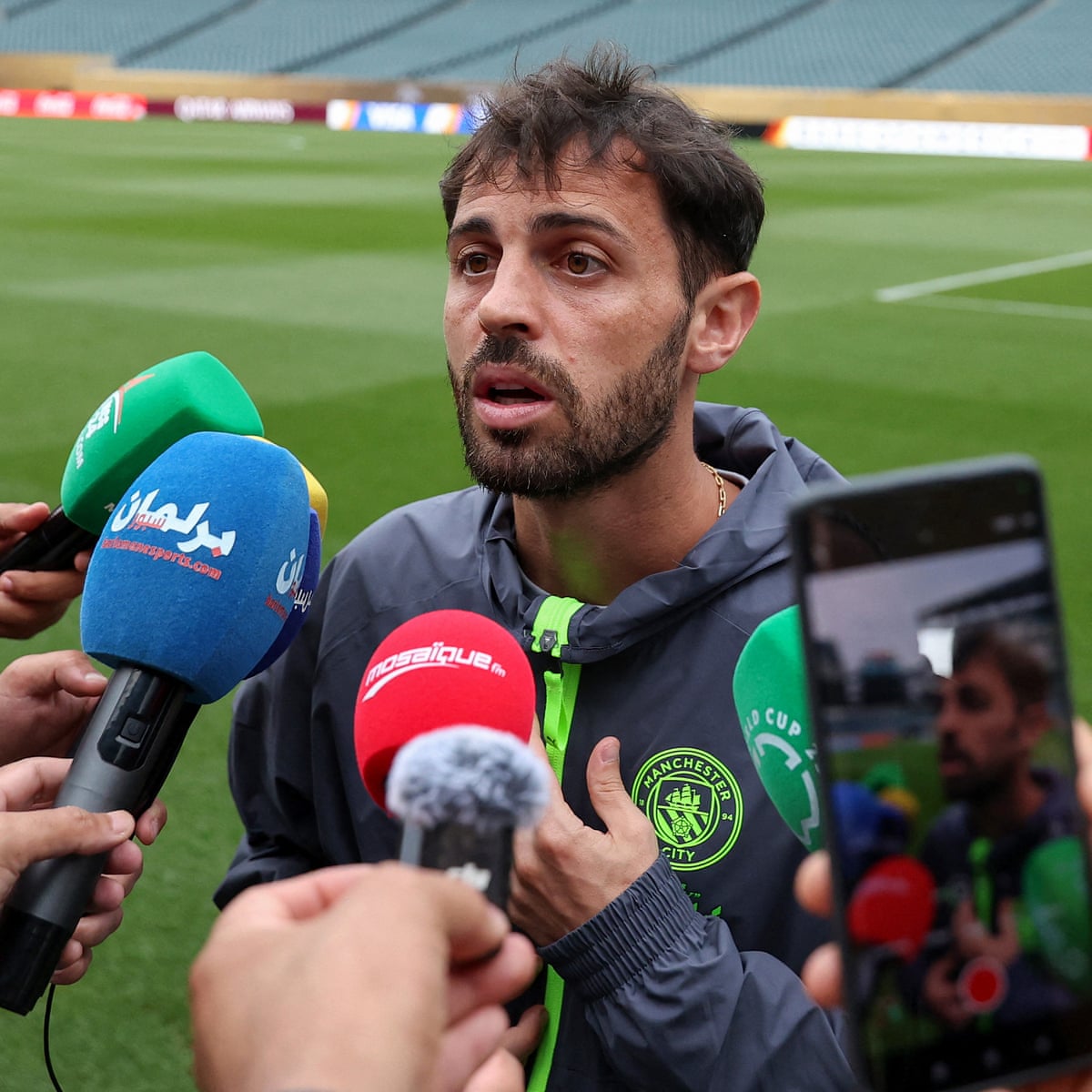
After nearly a decade of brilliance, consistency, and quiet leadership, Bernardo Silva is set to bring his remarkable chapter with Manchester City to a close. The club has now effectively confirmed that their captain will depart this summer on a free transfer—an exit that feels both inevitable and deeply emotional for fans and teammates alike.
While the midfielder has not made a dramatic public farewell announcement, the signs have been building for some time. As early as last summer, during the Club World Cup, Silva hinted that the current season would likely be his last in Manchester. Now, with only weeks remaining, those hints have crystallized into reality.

Assistant coach Pep Lijnders spoke openly about Silva’s impending departure, offering both praise and a sense of acceptance. For Lijnders, the Portuguese star represents a rare kind of footballer—one whose influence extends far beyond statistics or highlight reels.
“Every great story has an ending,” he suggested, emphasizing that Silva deserves a proper send-off. His comments carried a tone of admiration, but also a recognition that replacing a player like Silva will be anything but simple.
Indeed, Silva’s importance to Manchester City has only grown over time. This season, wearing the captain’s armband, he has played a key role in restoring the team’s intensity and discipline following what many viewed as a slight dip in standards the previous year. His work rate, tactical intelligence, and ability to adapt across multiple roles have made him indispensable in Pep Guardiola’s system.
Teammates often describe him as the player who connects everything—the one who senses when to slow the game down, when to press, and when to create space. Lijnders highlighted this instinctive understanding, noting that Silva seems to “feel” the game in ways that few others can.
That unique footballing brain is part of what makes his departure so significant. It’s not just about losing a talented midfielder; it’s about losing a player who embodies the rhythm and philosophy of the team.
Despite his deep connection to the club, Silva’s relationship with life in England has always been more complicated. Off the pitch, he has never fully hidden his preference for southern Europe. In a candid remark that quickly gained attention, he admitted that if Manchester City were based in Lisbon, he would happily remain until the end of his career.
That statement revealed a subtle but important truth: while Silva loves the club, the lifestyle in Manchester has never quite felt like home. For him and his wife, Ines, the pull of warmer climates, cultural familiarity, and proximity to family has remained strong.
This underlying tension helps explain why he has come close to leaving in previous years. During the COVID-19 period, there were serious discussions about a transfer, with Paris Saint-Germain emerging as a leading contender. However, negotiations fell short, largely due to Manchester City’s valuation of around £70 million.

Since then, interest in Silva has never really faded. Clubs across Europe have continued to monitor his situation, aware that a player of his quality rarely becomes available—especially on a free transfer.
Now, as his contract winds down, several have re-emerged. Juventus are reportedly keen to bring him to Italy, while long-time admirers FC Barcelona remain interested, though their financial constraints could complicate any move. There is also growing speculation about a potential switch to Major League Soccer, where a different pace of life might appeal to Silva at this stage of his career.
A return to SL Benfica—the club where he began his professional journey—has been discussed as well, but Silva himself has suggested that such a move may come later, rather than now.
As the season enters its final stretch, Silva’s focus remains firmly on the pitch. Manchester City are still chasing silverware, including another Premier League title. Although they currently trail Arsenal, they remain within striking distance, particularly with a game in hand.
Recent performances, including a commanding FA Cup victory over Liverpool, have reinforced the sense that City are not ready to relinquish their dominance just yet. For Silva, the motivation is clear: to add one more chapter of success before he leaves.
His departure will also mark the end of an era within the squad. Alongside him, other long-serving players are expected to move on, leaving Phil Foden as one of the few remaining links to the legendary 2017–18 “Centurions” team that redefined English football with their record-breaking campaign.
For fans, Silva’s exit is bittersweet. On one hand, there is pride in everything he has achieved—a collection of league titles, domestic cups, and unforgettable moments. On the other, there is the realization that players like him are incredibly rare.

Lijnders captured this sentiment perfectly when he joked about his own changing opinion of Silva. Initially unsure about him, he admitted that he has come to admire—and even love—the midfielder’s approach to the game. It’s a reflection of how Silva tends to win people over: not through flashiness, but through intelligence, humility, and consistency.
As the final weeks approach, attention will increasingly turn to how Manchester City chooses to say goodbye. Given his contributions, there is little doubt that Silva will receive a farewell worthy of his status. Whether through a final home appearance, a tribute from supporters, or a trophy lift, the club will want to ensure his legacy is properly honored.
For Silva himself, the ending seems to be unfolding exactly as he would want it—focused on football, grounded in professionalism, and free from unnecessary drama. There is no grand exit campaign, no prolonged speculation dominating headlines. Instead, there is simply a player giving everything he has until the very last moment.
And when that moment comes, it will mark the conclusion of one of the most quietly extraordinary careers in modern Premier League history.
Because while Bernardo Silva may be leaving Manchester City, the imprint he leaves behind—on the team, the fans, and the style of football they play—will endure long after he’s gone.