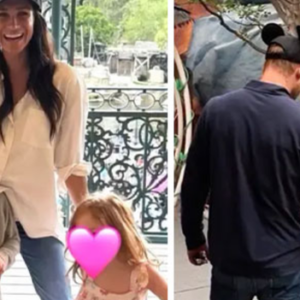
At first glance, the images seem almost too perfect—like scenes lifted from a carefully curated lifestyle magazine. A little girl, barefoot and laughing, dashes across a sunlit garden wearing bunny ears, clutching a basket and a soft toy. Nearby, her older brother concentrates intensely as he decorates Easter eggs, while their mother looks on with visible pride. It’s a portrait of idyllic family life, set against the lush backdrop of Montecito, California.
These moments were shared by Meghan Markle in a recent Instagram video, offering what many described as a rare glimpse into her private world with Prince Harry and their children. But the more these images circulate, the more observers are beginning to question not just what they show—but why they are being shown now.

Just days before the Easter post, Meghan had shared another intimate clip: her son, Archie, skiing with his father on a quiet, snow-covered slope. The video, captioned with maternal pride, presented a serene father-son moment—far removed from the pressures of public life. Reports suggested the trip took place at an exclusive Montana resort, where Harry had reportedly spent time with figures like Justin Trudeau and Olympic skier Eileen Gu. Whether Meghan was present remains unclear, adding a subtle layer of mystery to an otherwise wholesome narrative.
What stands out, however, is not just the content—but the pattern. For years, Meghan and Harry were known for fiercely guarding their children’s privacy. Early images of Archie were carefully staged, often obscuring his face. Later, photos of their daughter Lilibet followed a similar approach—taken from behind, partially hidden, or edited with emojis. This protective stance was consistent with their broader criticism of media intrusion and social media culture.
Yet recently, something has shifted.
In just a few months, Meghan has shared multiple posts featuring Archie and Lilibet—sometimes with their faces partially visible, sometimes more clearly than ever before. Compared to the approach of Prince William and Catherine, Princess of Wales—who have largely refrained from posting images of their children outside official occasions—the contrast is striking.
This apparent change in strategy has sparked speculation. Why now? What has prompted this gradual unveiling of family life?
Some insiders suggest that Meghan is consciously reshaping her public identity. After years defined by royal tension, media scrutiny, and high-profile projects, she may be pivoting toward something more personal and relatable: motherhood. In this narrative, the carefully curated images are not just family snapshots—they are part of a broader rebranding effort.

The idea is subtle but powerful. By presenting herself as a devoted, hands-on mother, Meghan taps into a universal experience—one that transcends titles and controversies. The images are warm, accessible, and emotionally resonant. They invite audiences to see her not as a duchess or public figure, but as a parent navigating everyday moments.
And yet, beneath the surface, there are contradictions.
Both Meghan and Harry have previously spoken out against the dangers of social media, particularly for young people. They have supported campaigns calling for greater accountability from tech companies and even welcomed legislation aimed at limiting children’s exposure to online platforms. In one statement, they described social media as a space that too often prioritizes profit over the well-being of families.
Given that stance, their increasing use of Instagram to share personal family moments raises questions. Is this a change in principle—or a strategic compromise?
One possible explanation lies in the evolving nature of public influence. In today’s media landscape, visibility often requires participation in the very platforms one might critique. For someone building a lifestyle-oriented brand, social media becomes not just a tool, but a necessity. Without it, reaching a broad audience becomes significantly more difficult.
This is where Meghan’s recent activities begin to align. In addition to her family-focused posts, she has made high-profile appearances—attending fashion events in Paris, appearing on magazine covers, and even returning briefly to acting. Each move suggests a deliberate effort to re-establish her presence across multiple spheres: fashion, entertainment, and now, lifestyle.
Meanwhile, Harry appears to be following a different path.
Since stepping back from royal duties, he has concentrated on philanthropic work, particularly through initiatives like the Invictus Games, which supports injured service members. He has also remained vocal on issues related to mental health and digital well-being, continuing to advocate for reforms in how online platforms operate.
This divergence—Meghan focusing on lifestyle and personal branding, Harry on advocacy and philanthropy—reflects a broader “brand separation” that has been noted by observers. While they remain united as a couple, their public roles are becoming increasingly distinct.
And perhaps that distinction is intentional.
By allowing each to pursue different avenues, they expand their collective reach while maintaining individual identities. Meghan’s emphasis on family life complements Harry’s focus on social impact, creating a dual narrative that appeals to different audiences.
Still, the question remains: what do these carefully curated images reveal—and what do they conceal?
On one level, they offer genuine glimpses of family life—moments of joy, connection, and normalcy. On another, they function as a form of storytelling, shaping how the Sussexes are perceived in a post-royal context. The idyllic garden scenes, the quiet ski slopes, the affectionate interactions—all contribute to a narrative of stability and happiness.
Yet the very perfection of these images invites scrutiny.
Critics argue that the posts feel overly polished, lacking the spontaneity that defines truly private moments. Supporters, on the other hand, see them as a natural evolution—an attempt to reclaim control over a narrative that has often been shaped by others.
In reality, the truth likely lies somewhere in between.
Meghan and Harry are navigating a complex space, balancing personal values with public expectations, privacy with visibility, and authenticity with strategy. Their recent posts are not just about sharing moments—they are about defining who they are now, outside the framework of the royal family.
As their story continues to unfold, these subtle shifts—what they share, how they share it, and when—will remain a key part of that evolution.
And in those sunlit images of Easter egg hunts and family holidays, there is more than meets the eye: not just a picture of happiness, but a carefully constructed window into a life still very much in transition.