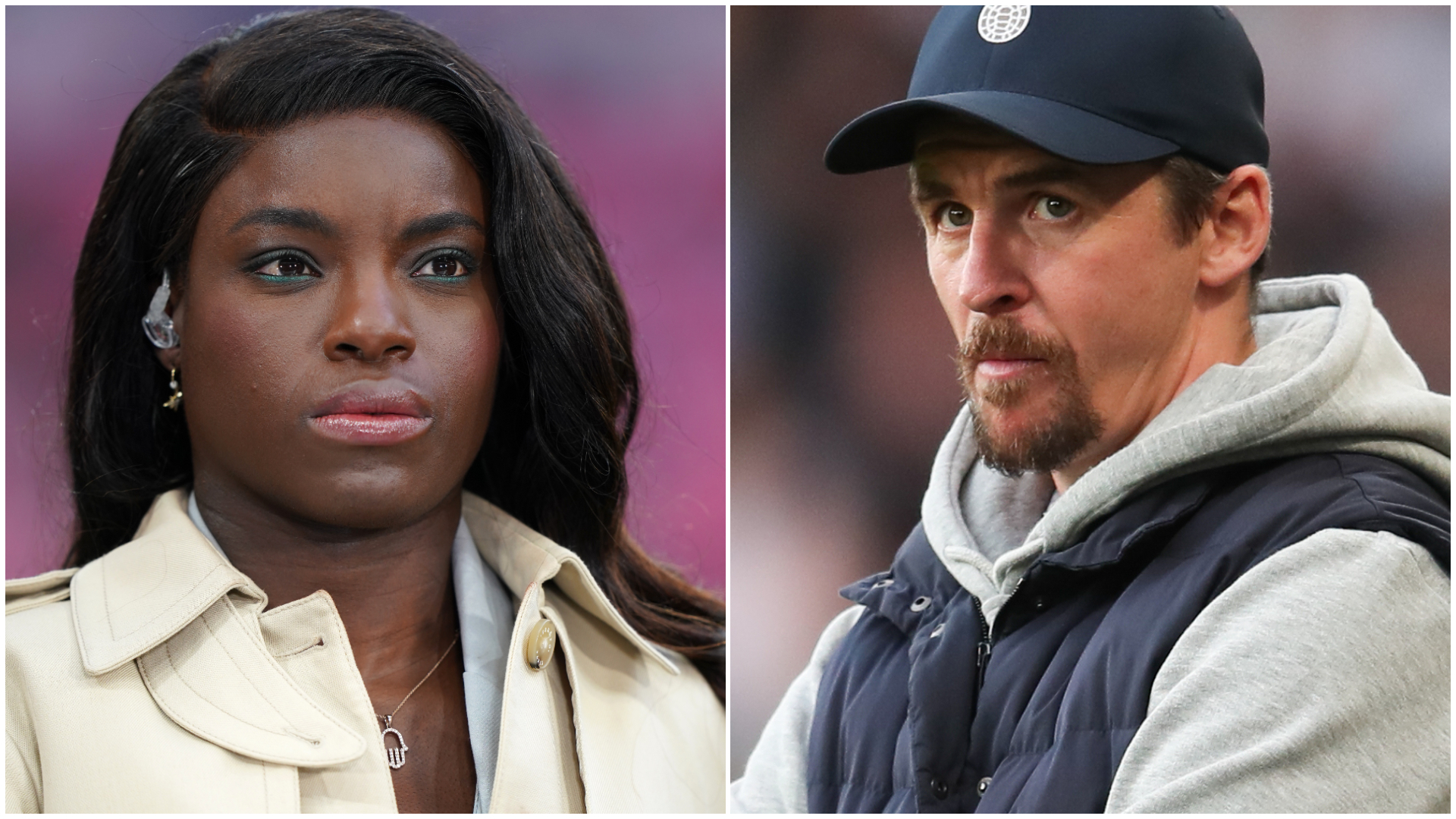
The ongoing court case involving Joey Barton has brought to light deeply troubling accounts from two prominent football broadcasters, revealing not only the content of controversial social media posts but also the profound personal impact they had. At the center of the testimony is Eni Aluko, who described a period of emotional and physical distress so severe that she said she struggled to get out of bed or even eat in the days following the incident.
The case, being heard at Liverpool Crown Court, revolves around a series of posts Barton made online, targeting Aluko and fellow commentator Lucy Ward. Prosecutors allege that these messages were not only offensive but intentionally harmful, contributing to a wave of harassment and intimidation. Barton, however, denies multiple charges related to sending grossly offensive communications.
The controversy stems from comments Barton made following coverage of an FA Cup match, where Aluko and Ward served as co-commentators. In one widely circulated post, he compared the two women to Fred West and Rose West—a reference that immediately drew outrage due to the severity and historical weight of those names. The comparison was later amplified when Barton reportedly edited an image to superimpose the broadcasters’ faces onto a photograph associated with the killers, escalating what might have been seen as criticism into something far more disturbing.
For Aluko, the shock was immediate and deeply personal. She told the court that her first reaction was confusion, questioning whether anything in her performance had warranted such an extreme response. Having previously exchanged friendly and supportive messages with Barton years earlier, she said the attack felt both unexpected and deeply unsettling. What began as disbelief quickly turned into something more тяжелое as the posts continued and intensified.
Aluko explained that the situation escalated beyond criticism of her work into what she perceived as a targeted attack on her identity. She pointed to additional posts in which Barton referenced diversity initiatives and broader social movements, suggesting that her presence in football broadcasting was undeserved. To her, these comments implied that she was only in her role because of her background, not her qualifications or experience. That shift—from professional critique to personal and identity-based remarks—was, she said, where the situation became especially harmful.
The impact was not limited to the initial posts. Aluko described how Barton’s large following amplified the situation, with others echoing similar sentiments online. The repetition of those messages created what she called a sense of being “under siege,” as the criticism spread far beyond the original source. It was no longer just one expressing an opinion—it became a of negativity that felt overwhelming and inescapable.
In her testimony, Aluko painted a vivid picture of how this affected her daily life. For nearly a week, she avoided leaving her home in London, fearing recognition and potential confrontation. On the rare occasion she did step outside, she said she felt the need to disguise herself. The emotional toll was significant: she described feeling intimidated, depressed, and unable to function normally. At one point, her mother came to stay with her, providing support during what she described as an extremely difficult time.
The situation reached a point where law enforcement became involved. After several days, police visited her home to take a statement. By then, Aluko said, she felt overwhelmed and unable to cope with the pressure. The combination of public attention, online harassment, and the nature of the comments themselves had taken a serious toll on her mental well-being.
The experience also had lasting effects on her career. Aluko told the court that the incident changed how she viewed her role in broadcasting. Once confident in her contributions, she began to question whether she could continue in the same way. Over the following months, she canceled multiple professional engagements, citing an inability to perform at her best while dealing with what she described as ongoing “hostile energy.”
Meanwhile, Ward shared her own account of the impact. She told the court that while she had anticipated criticism—particularly given Barton’s known views on women in men’s football—she had not expected the situation to escalate to this level. Initially shocked by the comparison to notorious killers, she said the of the posts made her feel increasingly uneasy. Over time, that unease turned into fear, with Ward admitting that she began to feel physically scared.
Ward emphasized that the issue was not just the content of the posts, but their effect. Even if some comments were framed as metaphor or opinion, she argued that the intent does not determine the impact. The person on the receiving end experiences the words in a very real way, especially when they are repeated and amplified. She described the situation as ongoing harassment, made worse by the encouragement it gave others to join in.
The defense, for its part, has argued that Barton’s comments fall within the realm of opinion and metaphor, questioning whether they were intended to be taken literally. However, both Aluko and Ward pushed back against this interpretation, stressing that the severity of the language—and the context in which it was delivered—made it impossible to dismiss as harmless commentary.
Beyond the legal arguments, the case has sparked a broader conversation about the role of women in sports broadcasting. Ward highlighted the progress that has been made, noting that expertise—not gender—should determine who is qualified to commentate. She pointed out that the quality of analysis varies among all commentators, regardless of background, and that the focus should remain on knowledge and insight rather than identity.
Aluko echoed similar sentiments, emphasizing that her career has been built on years of experience at the highest levels of the game. With over a hundred appearances for England and a professional career spanning top clubs, she argued that her credentials speak for themselves. The suggestion that she was only present due to external factors, she said, was both inaccurate and deeply hurtful.
As the trial continues, the case remains a focal point for discussions about online conduct, свобода of expression, and the responsibilities that come with a public platform. It highlights the тонкая линия between criticism and abuse, and the real-world consequences that can arise when that line is crossed.
For Aluko, the experience has left a lasting mark—not just on her personal life, but on her sense of security and professional identity. What began as a series of posts has evolved into a broader examination of how words, especially when amplified online, can shape perceptions, influence behavior, and profoundly affect those at the center of the storm.