On April 30, King Charles III and Queen Camilla undertook one of the most solemn and symbolically powerful moments of their state visit to the United States, stepping onto the sacred grounds of Arlington National Cemetery for a full honors wreath-laying ceremony at the Tomb of the Unknown Soldier. Marked by the thunderous echo of a 21-gun salute, the ceremony served as both a tribute to fallen soldiers and a poignant reflection of the enduring alliance between two nations whose histories have been deeply intertwined through conflict, sacrifice, and shared ideals.
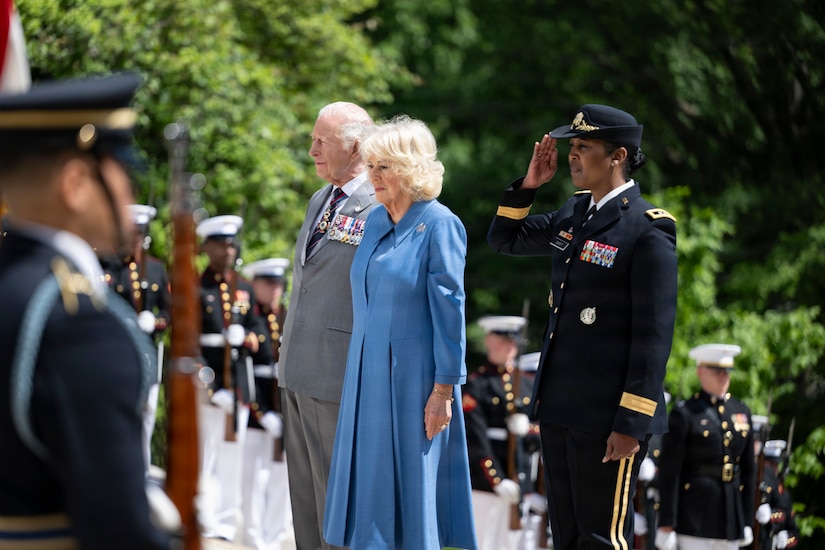
Taking place on the final day of their state visit—timed to coincide with the 250th anniversary of American independence—the ceremony carried profound historical resonance. It was not merely a diplomatic gesture, but a moment layered with symbolism, memory, and continuity. As the king and queen arrived, they were formally escorted by Antoinette Gant, commanding general of Joint Task Force–National Capital Region and the U.S. Army Military District of Washington, alongside Monica Crowley, who serves as ambassador, assistant secretary of state, and chief of protocol. Their presence underscored the importance of the occasion, bridging military tradition with diplomatic ceremony.
In a moment of solemn unity, the royal couple stood at attention as the United States Army Band “Pershing’s Own” performed both “God Save the King” and The Star-Spangled Banner. The dual performance of the British and American national anthems encapsulated the spirit of transatlantic partnership—two nations distinct in identity yet united through history, values, and shared sacrifice on battlefields across generations.
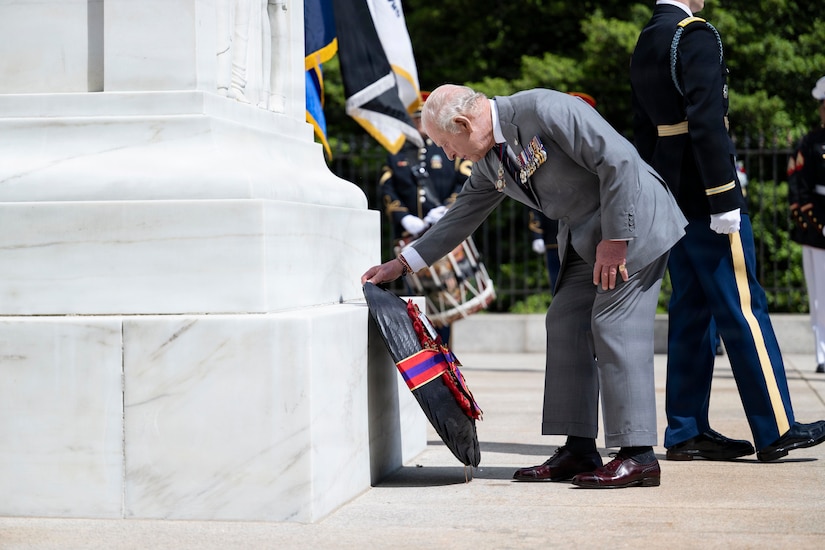
At the heart of the ceremony, King Charles III approached the Tomb of the Unknown Soldier and laid a meticulously arranged wreath composed of red poppies. The poppy, long recognized across the British Commonwealth as a symbol of remembrance dating back to World War I, carried deep emotional and historical weight. Attached to the wreath was a handwritten note from the king bearing the simple yet powerful words: “In everlasting remembrance.” The message, understated yet profound, echoed the enduring duty to honor those who gave their lives in service.
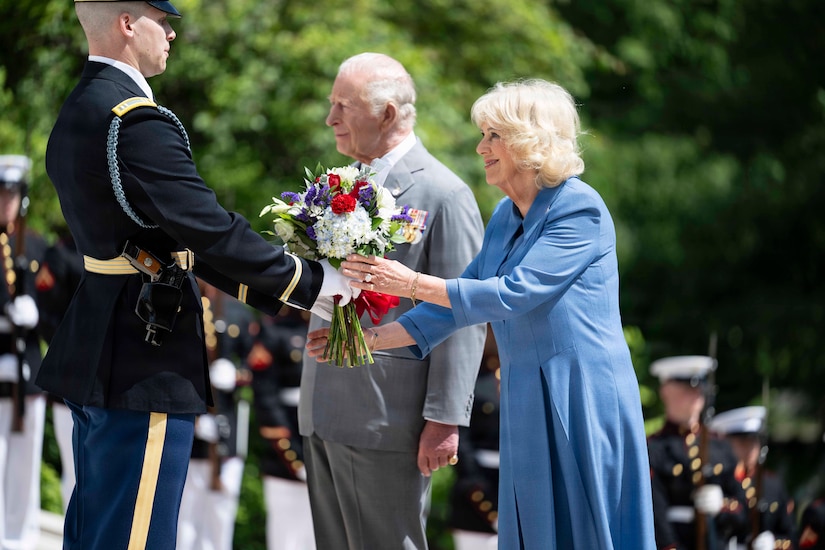
Following the king’s tribute, Queen Camilla stepped forward to place a bouquet of red, white, and purple flowers beside the wreath. Her gesture complemented the king’s offering, adding a personal and human touch to the ceremonial tribute. Together, their actions reflected a shared commitment to remembrance—not only as representatives of the British monarchy, but as individuals acknowledging the universal cost of war.
The Tomb of the Unknown Soldier itself stands as one of the most revered memorials in the United States. Dedicated on November 11, 1921, it originally commemorated an unidentified American soldier who died during World War I. Over time, it came to represent unknown service members from subsequent conflicts, including World War II and the Korean War. Its very existence is rooted in a shared tradition with the United Kingdom, whose own Tomb of the Unknown Warrior was established one year earlier. Both memorials symbolize a collective act of remembrance, honoring not just individual sacrifice, but the anonymity of countless lives lost in war.
What makes this connection particularly poignant is that the soldiers commemorated at these sites fought in conflicts where the United States and the United Kingdom stood as allies. From the trenches of World War I to the global struggle of World War II and beyond, the two nations have repeatedly found themselves united in defense of shared principles. The tomb, therefore, serves not only as a national monument but as a testament to international solidarity forged through hardship.
After the wreath-laying ceremony, the royal couple proceeded to the Memorial Amphitheater, where they were welcomed by Karen Durham-Aguilera, executive director of Army National Military Cemeteries and the Office of Army Cemeteries. In her remarks, Durham-Aguilera emphasized the significance of the visit, describing Arlington as “honored” to host the king and queen during such a historic milestone. She highlighted the “enduring bond” between the United States and the United Kingdom, framing it as a testament to shared history, mutual respect, and collective sacrifice.
The visit continued with a stop at the Canadian Cross of Sacrifice, a lesser-known yet deeply meaningful memorial within the cemetery grounds. This monument commemorates American volunteers who fought and died with the Canadian Expeditionary Force during World War I—before the United States officially entered the conflict. Designed by British architect Reginald Blomfield for the Commonwealth War Graves Commission, the Cross of Sacrifice stands as a symbol of international cooperation and shared remembrance across Commonwealth nations.
This particular stop carried an additional layer of personal significance for King Charles III. In 1957, his parents, Queen Elizabeth II and Prince Philip, paid tribute at the same memorial during their own state visit to the United States. By following in their footsteps, the king and queen not only honored history but also reinforced a sense of continuity within the monarchy—linking past, present, and future through acts of remembrance.
At the Cross of Sacrifice, the royal couple was joined by service members representing not just the United States and the United Kingdom, but also Canada, New Zealand, and Australia. Their presence highlighted the broader network of alliances that extend beyond bilateral relations, encompassing a global community shaped by shared history and collective memory.
Described by the British Embassy as “one of the most symbolically significant acts of remembrance a foreign dignitary can undertake on American soil,” the visit to Arlington National Cemetery served as a powerful reminder of the enduring ties between the United States and the United Kingdom. It was a moment that transcended politics and diplomacy, reaching into the deeper realms of memory, sacrifice, and human connection.
In an era often defined by shifting geopolitical landscapes, such gestures carry renewed importance. They reaffirm not only alliances between governments but also bonds between peoples—rooted in shared experiences of loss, resilience, and hope. The image of King Charles III and Queen Camilla standing in silent tribute, surrounded by history and sacrifice, will likely endure as one of the defining moments of their state visit.
Ultimately, the ceremony at Arlington was not just about honoring the past—it was about reaffirming a commitment to remembrance in the present and for future generations. Through their actions, the king and queen underscored a timeless truth: that the sacrifices of those who came before must never be forgotten, and that the bonds forged in those moments of sacrifice continue to shape the world today.