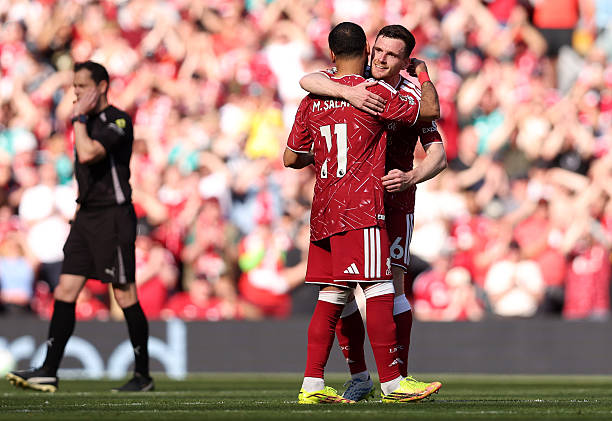
“It feels like the end of an era,” said Mohamed Salah, posting a deeply emotional message on social media after a private farewell gathering held in Liverpool. The words alone were simple, but the sentiment behind them carried significant weight, capturing a moment that felt far bigger than an ordinary team dinner. The occasion, co-hosted by Salah and teammate Andy Robertson at Bacaro in Liverpool, brought together the full squad of Liverpool FC, along with coaching staff and senior club officials, in what felt like a closing chapter to a long and defining era.
What was initially described as a warm, intimate celebration quickly revealed itself to be something more meaningful. Rather than a routine end-of-season meal or casual team night out, the gathering carried an emotional undertone from the very beginning. Players arrived not just as colleagues, but as people who had shared years of pressure, triumph, disappointment, and transformation. The atmosphere inside the venue reportedly shifted between laughter, reflection, and quiet moments where conversations lingered a little longer than usual, as if nobody quite wanted the night to end.
Salah’s post following the event suggested that the evening stirred more than just nostalgia. His message hinted at the weight of nearly a decade spent at the club, describing memories that seemed to surface all at once—some joyful, others more complex and difficult to define publicly. Without stating everything directly, his tone implied that the journey had been filled with unseen struggles as well as celebrated victories, suggesting that what fans see on the pitch is only a fraction of the full story.
In his reflection, Salah referenced the idea that time at the club had shaped him in ways that went beyond football. He spoke in broad emotional terms about growth, change, and unity, hinting that the bonds formed within the squad extended far deeper than tactical systems or match results. The implication was that these relationships, built through shared experiences over years, had become a defining part of his life in England.
The choice of Bacaro in Liverpool as the venue added to the sense of intimacy. Known for its warm lighting and close, communal setting, the restaurant created a space that felt intentionally removed from the public spotlight. There were no cameras inside, no formal speeches announced in advance, and no public ceremony. Instead, the evening unfolded organically, with conversations flowing between teammates who have shared countless matches, training sessions, and high-pressure moments together.
At different points in the night, laughter reportedly broke out as players revisited old stories—some from early seasons when the squad was still finding its identity, and others from more recent campaigns where success had become more consistent but expectations even higher. These recollections were not just about victories, but also about setbacks: painful defeats, near misses in major competitions, and the emotional toll of competing at the highest level year after year.
Within this reflective atmosphere, Salah and Robertson were seen moving between groups, engaging with both players and staff. Their roles as hosts gave the evening a subtle structure, but it never felt formal or controlled. Instead, it resembled a collective pause—an opportunity for everyone present to acknowledge how far the team had come together.
There was also a noticeable sense that the gathering symbolized transition. While no official announcements were made, Salah’s phrasing—especially his reference to an “era ending”—led many to interpret the night as more than just a celebration. It suggested awareness of change ahead, whether in squad evolution, personal journeys, or the natural cycle of football careers. The emotional weight of that possibility lingered beneath the surface of the event.
Some attendees reportedly spoke about the uniqueness of the bond within the squad, describing it as something forged not only through success but also through adversity. Over the past nine years, Liverpool FC has experienced dramatic highs, including major domestic and European triumphs, as well as periods of rebuilding and adjustment. That shared timeline has created a sense of collective identity that was clearly present during the farewell gathering.
Salah’s social media post the following day added another layer of meaning to the evening. While he did not go into explicit detail, his wording suggested that the experience left him reflective about time, loyalty, and the nature of football itself. He appeared to acknowledge that careers at elite clubs are defined not only by trophies and statistics, but also by the relationships and memories built behind closed doors.
The phrase “end of an era” resonated strongly with supporters, many of whom immediately interpreted it as a symbolic moment. Fans responded by sharing highlights of key moments from Salah’s time at the club, from decisive goals to iconic celebrations, as well as Robertson’s tireless contributions from defence and leadership on and off the pitch. The emotional response online quickly turned the post into a focal point for reflection on what this generation of players has meant to the club’s modern identity.
Yet, despite the emotional tone, the farewell was not framed as an ending in a strictly literal sense. There was no formal announcement of departures or retirements. Instead, the sentiment felt more like recognition of a natural turning point—an acknowledgment that football teams evolve continuously, and that even the strongest eras eventually shift into new phases.
Within that context, the dinner at Bacaro can be seen as both a celebration and a quiet farewell to a shared chapter. The players were not saying goodbye to the club itself, but rather to a specific version of it—the version they had built together over many seasons of competition, resilience, and achievement.
As the night drew to a close, the mood reportedly softened. Conversations became more personal, with players speaking less about football and more about families, future plans, and life beyond the pitch. It was in these quieter exchanges that the emotional reality of Salah’s message seemed most present: a recognition that time moves forward, and that even the most successful eras are eventually remembered in fragments of moments like this.
By the end of the gathering, what remained was not sadness alone, but a mixture of gratitude and reflection. The event had allowed those present to step outside the intensity of competition and simply acknowledge what they had built together. In doing so, it gave shape to something that cannot always be captured in statistics or headlines—the human side of football.
Salah’s final message, understated but powerful, left supporters with a lingering sense that they had been given a rare glimpse behind the curtain. Not everything about the past nine years was spelled out, but enough was revealed to understand its depth. The story of this Liverpool generation, as the evening suggested, is not just about what was achieved on the pitch, but also about the invisible bonds that made those achievements possible—and the quiet understanding that every era, no matter how successful, eventually finds its moment to change.