End of the Road at Old Trafford: Rasmus Hojlund Completes Permanent Napoli Move as Manchester United Reshape Their Future
Manchester United have officially confirmed the departure of Rasmus Hojlund, bringing an end to a chapter that began with enormous expectations but ultimately failed to deliver the impact many supporters had hoped for.
The Danish striker has completed a permanent transfer to Napoli in a deal worth approximately £38 million, a figure that represents nearly half of the total package United committed to when they signed him from Atalanta in 2023 for a fee that could rise to £72 million.
While the transfer may be viewed by some as a disappointing financial outcome, club insiders believe the move is part of a much broader rebuilding strategy taking shape behind the scenes at Old Trafford.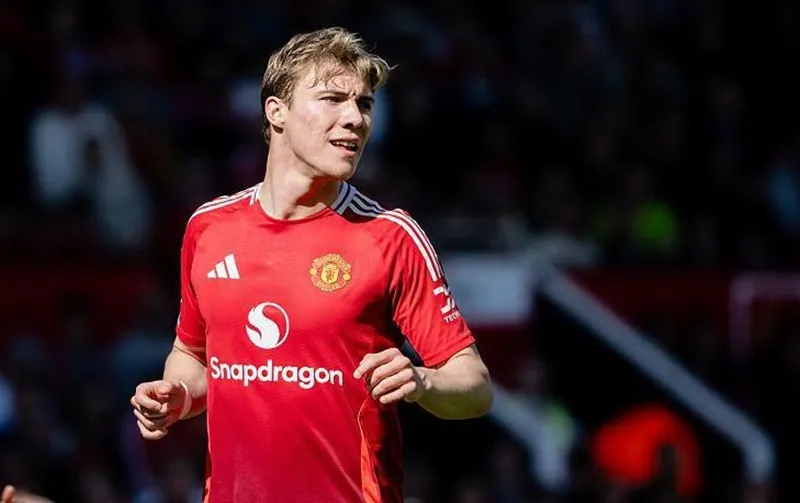
The sale not only removes a player who had fallen down the pecking order but also helps provide funding for Manchester United’s pursuit of Atalanta midfielder Ederson, one of the club’s primary transfer targets this summer.
The announcement immediately sparked widespread discussion among supporters and football analysts.
Some viewed the transfer as an admission that the original investment had not worked out as planned. Others argued that the move demonstrated a willingness by United’s leadership to make difficult decisions in order to accelerate the squad’s evolution.
For Hojlund himself, however, the transfer offers an opportunity to restart his career in an environment where he has already proven he can thrive.
After spending the 2025-26 season on loan with Napoli, the 23-year-old striker rediscovered much of the confidence that had occasionally been missing during his time in England.
Across all competitions, he scored 16 goals in 44 appearances, helping Napoli remain competitive both domestically and internationally.
His contributions played an important role as the Italian side secured the Supercoppa Italiana and finished among the top teams in Serie A.
Those performances convinced Napoli to activate the purchase clause included in the original loan agreement.
The transfer became automatic once the Italian club secured qualification for the UEFA Champions League, having already paid Manchester United £5.2 million for the season-long loan.
In an official statement, United thanked Hojlund for his service and wished him success in the next phase of his career.
The statement highlighted his 26 goals in 95 appearances for the club, while also acknowledging his role in United’s FA Cup triumph in 2024.
Although his statistics were respectable, many observers believe they never fully reflected the expectations that accompanied his arrival.
When Hojlund joined United from Atalanta, he was viewed as one of Europe’s most promising young forwards.
Supporters hoped he would become the long-term solution to the club’s attacking problems.
The pressure was immense from the start.
Every goal drought attracted headlines.
Every missed opportunity generated scrutiny.
Every comparison to previous United strikers increased expectations even further.
Despite flashes of quality, consistency proved difficult to achieve.
The challenge became even greater following the arrival of Benjamin Sesko last summer.
United invested heavily once again, spending approximately £74 million to secure the highly-rated Slovenian striker.
The arrival of another major attacking signing inevitably reduced Hojlund’s opportunities.
As the season progressed, it became increasingly clear that his future might lie elsewhere.
Napoli’s interest provided the perfect solution for all parties involved.
The striker was able to return to a league where he previously enjoyed success, while United gained both financial flexibility and room within the squad.
Yet the significance of the deal extends beyond Hojlund’s departure.
Sources close to the club suggest that the transfer forms part of a wider restructuring effort designed to improve balance across the squad.
Manchester United have already agreed terms with Atalanta regarding Brazilian midfielder Ederson, with the proposed deal reportedly worth around £38 million.
Club executives believe the midfielder could provide energy, defensive stability, and technical quality in an area of the pitch that has required reinforcement for several seasons.
Interestingly, the near-identical values of the two transfers have fueled speculation among supporters that United effectively used the Hojlund sale to finance the Ederson acquisition.
While football finances are rarely that straightforward, the symbolism has not gone unnoticed.
Many fans have described the move as a strategic reallocation of resources rather than simply accepting a loss on a former signing.
Social media platforms were flooded with reactions shortly after the announcement.
Some supporters expressed disappointment that Hojlund never fully developed into the prolific striker they envisioned.
Others offered messages of support, arguing that circumstances at United made it difficult for many young players to reach their potential.
Several former players and pundits noted that moving clubs at the right time can sometimes be the best decision for both the individual and the organization.
For Napoli supporters, meanwhile, the transfer has been welcomed enthusiastically.
Many fans believe Hojlund’s best years remain ahead of him.
His successful loan spell demonstrated that he can adapt to the tactical demands of Italian football while continuing to develop physically and technically.
The permanent deal now provides stability and allows the striker to focus entirely on his future with the club.
Meanwhile, Manchester United’s transfer activity appears far from complete.
The club is also exploring permanent solutions involving several other high-profile players.
Marcus Rashford, who spent the season on loan at Barcelona, remains the subject of ongoing discussions.
Barcelona possess an option to make the move permanent, although reports suggest negotiations regarding the final valuation remain ongoing.
Similarly, goalkeeper Andre Onana’s future remains uncertain following his loan spell with Trabzonspor.
The Turkish club would like to retain his services, but financial considerations may ultimately determine whether a permanent transfer becomes possible.
These situations illustrate the broader challenge facing Manchester United’s recruitment department.
After years of expensive signings and mixed results, the club is attempting to build a more sustainable squad structure.
That process inevitably requires difficult decisions.
Popular players may depart.
Former investments may be written down.
And short-term criticism may be necessary in pursuit of long-term progress.
The departure of Hojlund fits into that larger narrative.
While some will remember the transfer as a costly gamble that failed to meet expectations, others may view it as a valuable lesson in recruitment and squad planning.
Football careers rarely follow straight lines.
Players flourish in some environments and struggle in others.
At just 23 years old, Hojlund still has ample time to fulfill the potential that attracted Europe’s biggest clubs only a few years ago.
For Manchester United, the focus now shifts toward what comes next.
The arrival of new talent, the pursuit of midfield reinforcements, and ongoing efforts to reshape the squad suggest that the club’s summer business is only beginning.
As one chapter closes with Hojlund’s departure, another is opening.
Whether the decision ultimately proves successful will depend not only on how the Danish striker performs in Naples but also on how effectively United use the resources generated by the move.
For now, both club and player appear ready to embrace a fresh start—one that could significantly influence the future direction of their respective ambitions.