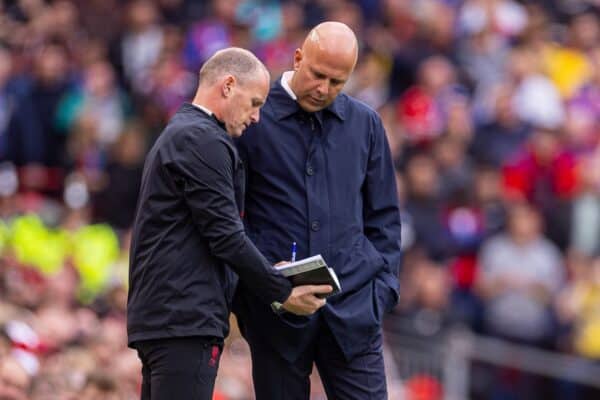
Arne Slot’s coaching reshuffle continues to develop in unexpected ways as Feyenoord prepare for a new era under fresh leadership, with the Dutch club confirming discussions involving another member of the manager’s former backroom team.
Following recent structural changes within the club’s coaching department, Feyenoord have already moved to appoint Giovanni van Bronckhorst as head coach, marking his return for a second spell in charge. Alongside him, Sipke Hulshoff has been installed as assistant manager, reuniting key figures from the club’s recent past.
These appointments form part of a wider rebuilding process after a series of departures linked to Arne Slot’s exit and the subsequent changes at Liverpool. When Slot left his role at Anfield, it triggered a wider restructuring of his trusted coaching group, many of whom had worked closely with him across multiple clubs.
Among those who departed were assistant coach Sipke Hulshoff, lead physical performance coach Ruben Peeters, and first-team tactical analyst Roderick van der Ham. Several members of this group had been integral to Slot’s coaching philosophy, having worked with him over a number of years and across different environments, including Feyenoord and Liverpool.
Since then, some members of the former staff have already secured new positions, while others are still considering their next steps in professional football.
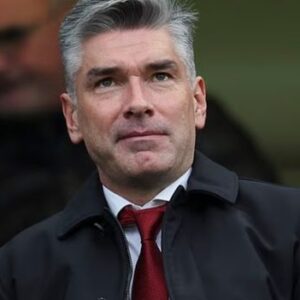
The most recent development came during Feyenoord’s official announcement of Van Bronckhorst’s return as head coach. At the unveiling press conference, technical director Davy Rigaux revealed that the club also intends to hold discussions with Ruben Peeters regarding a possible return to De Kuip.
Rigaux confirmed that he has a personal connection with Peeters and that conversations are expected to take place once the performance coach returns from holiday. However, he emphasized that the decision ultimately rests with Peeters himself, who will determine his future direction.
According to Rigaux, Feyenoord are keen to explore the possibility of bringing him back into the club’s structure, given his previous experience and familiarity with the environment. He suggested that discussions would happen in due course, without placing pressure on the individual’s decision-making process.
Peeters’ potential return would be seen as a significant development, given his close working relationship with Arne Slot over a five-year period across two different clubs. During that time, he played an important role in shaping the physical preparation and performance standards of Slot’s teams.
His understanding of Slot’s methods and training philosophy made him a key figure within the coaching setup, particularly during the successful periods at both Feyenoord and later Liverpool.
Similarly, Sipke Hulshoff, who has already been confirmed as Van Bronckhorst’s assistant at Feyenoord, also shared a long-standing professional connection with Slot. Hulshoff worked alongside the Dutch coach for approximately five years across multiple roles, including spells at SC Cambuur, Feyenoord, and Liverpool.
His decision to return to Feyenoord marks a notable shift, as he moves away from Slot’s coaching circle and into a new leadership structure under Van Bronckhorst.
Feyenoord’s new direction, however, is not aimed at simply replicating the previous Slot-era setup. Club officials have made it clear that their intention is not to recreate what they described as an “Arne Slot effect,” but rather to build a refreshed identity under the current coaching leadership.
Despite this, the influence of Slot’s former staff remains visible within the club’s ongoing planning, particularly as they consider whether to reintegrate experienced figures such as Peeters.
Meanwhile, Arne Slot himself finds himself at a crossroads following the dispersal of his coaching team. With several of his long-time collaborators moving on, the manager is now operating without many of the key individuals who previously supported his tactical and physical preparation systems.
The restructuring has raised questions about his next career move and the type of coaching environment he will build in future roles.
Earlier reports suggested that Slot had already declined an opportunity to take over as head coach of Fulham in the Premier League. The English club were believed to have been interested in his services, but he ultimately decided not to pursue the offer. Former Liverpool defender Álvaro Arbeloa has since emerged as the leading candidate for that position.
Speculation now continues regarding Slot’s long-term plans. In the Netherlands, there is growing expectation that he may eventually be considered for the national team managerial role, particularly if current head coach Ronald Koeman steps down following the upcoming World Cup.
Such a position would represent a significant shift in responsibilities compared to club management. International coaching setups typically require a different structure, with less day-to-day involvement and a reduced reliance on large, permanent backroom teams.
This potential transition may also explain why some of Slot’s former staff have chosen different career paths. For instance, Hulshoff’s decision to join Van Bronckhorst at Feyenoord is seen by some observers as a move toward stability and continuity within a familiar club environment, rather than waiting for future opportunities tied to Slot’s next appointment.
As for Feyenoord, the newly appointed coaching duo of Van Bronckhorst and Hulshoff have signed initial two-year contracts, with an option for an additional year depending on performance and mutual agreement.
The club is preparing for the start of a new Eredivisie campaign under their leadership, with their opening fixture scheduled against local rivals Sparta Rotterdam on August 9. The match is expected to mark the beginning of a fresh chapter for the Rotterdam-based side as they aim to re-establish themselves at the top level of Dutch football.
While the focus now shifts toward the new season, the wider coaching landscape continues to evolve. The movements of staff associated with Arne Slot underline how closely interconnected modern football coaching teams have become, with managerial changes often triggering ripple effects across multiple clubs and roles.
As Feyenoord look to the future with Van Bronckhorst at the helm, and Slot considers his next step in management, the story of this coaching network remains one of transition, continuity, and ongoing professional realignment within European football.