Popular YouTube personality Angry Ginge has criticized security staff following England’s FIFA World Cup match against Ghana, claiming stadium officials failed to respond appropriately after he reported a spectator for allegedly making racist remarks during the game.
The online creator, whose real name is Morgan Burtwistle, attended England’s second Group L fixture in Boston on Tuesday evening. While the match itself ended in a goalless draw, Burtwistle said an incident involving a fellow supporter became the most disturbing part of the night.
England entered the match with confidence after an entertaining 4-2 victory over Croatia in their opening group game in Dallas. However, despite dominating long spells against Ghana, the Three Lions were unable to find a breakthrough, settling for a single point.
According to Burtwistle, events in the stands overshadowed the action on the pitch.
Following the match, the 24-year-old uploaded a video to social media explaining that a man seated directly in front of him had allegedly made racist comments aimed at members of the Ghana national team. Burtwistle said he immediately decided to report the incident to nearby stewards because he believed such behavior should never be tolerated inside a football stadium.
While filming after the game, he pointed toward the now-empty seat where the supporter had been sitting and explained that he had alerted security staff. He stressed that football’s long-running anti-racism message, often summarized by the slogan “Kick It Out,” should be enforced consistently whenever discriminatory behavior occurs.
Burtwistle argued that anyone found making racist remarks should lose the privilege of attending football matches. In his view, supporters who engage in discriminatory abuse have no place inside stadiums and should be removed immediately.
A message displayed during his video further explained why he had confronted the individual. According to the caption, the man had repeatedly directed highly offensive racist comments toward Ghana’s players, leaving Burtwistle convinced that reporting the behavior was the only responsible course of action.
Despite informing stadium staff, Burtwistle claimed the initial response left him frustrated.
He said one steward told him that officials could not immediately eject the supporter because they would need to witness another incident before taking stronger action. Burtwistle strongly disagreed with that explanation.
According to him, multiple people seated nearby had heard the comments and could confirm what had been said. He argued that eyewitness accounts should have been sufficient for stadium staff to intervene without waiting for additional offensive remarks.
In the video, Burtwistle explained that he insisted the supporter should be removed immediately rather than being given another opportunity to repeat the alleged abuse. He said security personnel eventually contacted a supervisor after he challenged their handling of the situation.
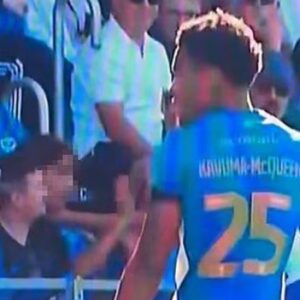
Although Burtwistle did not publicly repeat the specific words allegedly used by the supporter, footage included in his video captured a brief exchange between the two men.
The supporter turned around and apologized for what he had said, acknowledging that his comments about Ghana had been inappropriate. He expressed regret and suggested that the incident be forgotten, adding that he would not make similar remarks again.
Burtwistle rejected the apology, making it clear that he did not believe racism should simply be overlooked because someone apologized after being confronted.
He responded by questioning how anyone could expect others to ignore racist behavior, emphasizing that such conduct deserves consequences rather than forgiveness in the moment.
The exchange quickly attracted attention online, with many viewers discussing both the alleged incident itself and the response from stadium officials.
Burtwistle later claimed that while security eventually removed the supporter from his original seat, he was not actually expelled from the venue.
Instead, according to Burtwistle, the man was simply relocated to another section of the stadium, where he remained for the rest of the match. Burtwistle said he and others saw the individual again while leaving the stadium after the final whistle.
That outcome left him deeply dissatisfied with the way the situation had been handled.
He argued that moving someone accused of racist behavior to another seating area sends the wrong message and undermines football’s ongoing campaigns against discrimination.
Burtwistle also criticized what he described as inconsistent enforcement of anti-racism policies. Before major football matches, supporters often hear public announcements encouraging them to report discriminatory abuse by reminding fans to “see it, say it.” Burtwistle said he followed exactly that guidance by reporting the alleged incident as soon as it happened.
However, he believes the authorities failed to match those public commitments with meaningful action.
According to Burtwistle, if supporters are encouraged to report offensive conduct but those responsible are allowed to remain inside the stadium, confidence in the reporting system could be weakened.
He argued that football organizations, stadium operators, and event security all have a responsibility to demonstrate that racism will not be tolerated under any circumstances.
The incident also reignited wider conversations about discrimination in football. Governing bodies, clubs, and tournament organizers have spent years introducing campaigns designed to eliminate racist abuse from the sport. These efforts include educational initiatives, stricter stadium regulations, reporting systems, and sanctions against offenders.
Even so, isolated incidents continue to occur at matches around the world, prompting ongoing debate over whether existing policies are being enforced consistently enough.
Many supporters believe immediate removal from stadiums is the appropriate response when credible reports of racist behavior are made, while others argue investigations should take place before severe penalties are imposed. Burtwistle’s criticism focused largely on what he viewed as an unnecessary delay in responding after multiple witnesses allegedly heard the offensive remarks.
The controversy unfolded during a match that otherwise carried significant importance for England’s World Cup campaign.
After defeating Croatia in their opening fixture, England entered the game hoping to secure another victory that would strengthen their position at the top of Group L. Ghana, managed by experienced coach Carlos Queiroz, produced a disciplined defensive performance that frustrated England throughout the evening.
Neither side managed to score, leaving both teams with valuable but contrasting results as the group stage continued.
Despite the competitive significance of the match, much of the online discussion afterward centered on Burtwistle’s video rather than the football itself.
His comments sparked debate across social media, with many users praising his decision to challenge the alleged behavior and report it to security. Others questioned how stadium officials should handle similar situations when accusations arise during live sporting events.
For Burtwistle, however, the central issue remained unchanged. He believes football should be a welcoming environment for supporters of every background and nationality, and that discriminatory behavior must be dealt with decisively.
Reflecting on the incident after leaving the stadium, he maintained that the response from security staff fell well short of the standards promoted by football’s anti-racism campaigns. In his opinion, supporters who engage in racist abuse should not simply be moved to another seat but should instead be removed from the venue entirely.
The incident has added another chapter to the sport’s continuing efforts to combat discrimination, highlighting both the importance of spectators reporting unacceptable behavior and the ongoing debate over how stadium officials should respond when such allegations arise during major international tournaments.