Argentina Players Face Uncertain Wait Over Possible FIFA Ban After Displaying ‘Malvinas’ Banner Following Victory Against England
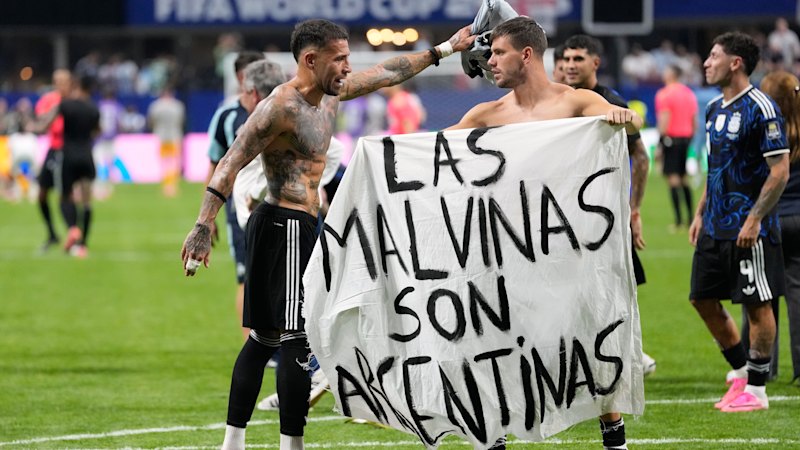
FIFA has launched a review process that could lead to disciplinary measures against members of the Argentina national team after they held up a provocative banner asserting their country’s longstanding claim over the Falkland Islands (referred to as Las Malvinas in Argentina) during celebrations following their semi-final win over England in the World Cup.
Following a tense 2-1 victory, several Argentina players, including two who currently play club football in England, proudly raised the sign in front of fans and cameras. The action has sparked significant controversy, particularly in the United Kingdom, where it has reignited sensitivities surrounding the disputed South Atlantic islands.
UK Prime Minister Sir Keir Starmer has voiced support for calls to investigate the incident, backing Business Secretary Peter Kyle’s request for FIFA to examine the matter thoroughly. The banner incident has drawn widespread attention and criticism in Britain, with many viewing it as an inappropriate political statement during a sporting event.
FIFA’s regulations strictly prohibit any form of political messaging or demonstrations at World Cup matches and related activities. However, the organization has previously overlooked similar references to the 1982 conflict that have appeared in songs sung by the Argentine players and shared on social media by the national football association throughout the tournament.
At the conclusion of the hard-fought semi-final match, players including Manchester United defender Lisandro Martínez and Tottenham Hotspur’s Cristian Romero were among those who lifted the banner displaying the words “Las Malvinas son Argentinas” — translating to “The Malvinas are Argentine.” This public display immediately captured global headlines and fueled heated debate on both sides of the issue.
It remains unclear whether any potential investigation or sanctions by FIFA could be resolved in time for Sunday’s World Cup final against Spain. Daily Mail Sport has sought official clarification from FIFA regarding the timeline.
In response, a FIFA spokesman issued a measured statement: “As is standard procedure, FIFA’s independent Disciplinary Committee is currently assessing the match reports and considering the relevant circumstances before deciding on potential further steps based on the FIFA Disciplinary Code.”
The political fallout has reached high levels in the UK government. A spokesman for Prime Minister Starmer emphasized Britain’s firm stance on the matter: “The World Cup might not be ours, but the Falkland Islands definitely are. Our position is unchanged. Self-determination rests with the islanders and our commitment to the Falklands will never waver.”
When asked whether the players who held the banner should face a ban from the final, the spokesman declined to dictate FIFA’s actions but reiterated broader principles. “More broadly, potential action is a matter for FIFA, but it’s been a fantastic World Cup and we’ve said throughout that politics should stay out of football.”
Regarding the upcoming final, the Prime Minister’s office indicated that Starmer wishes both Argentina and Spain well, with a particular note of encouragement for Spain.
Business Secretary Peter Kyle strongly condemned the banner as “an egregious violation of the rules of not having political activity as part of the football” during an interview with the BBC. His comments reflect the deep frustration felt in parts of the UK over the mixing of historical territorial disputes with international sports.
The controversy touches on a painful chapter in history. In 1982, Argentina invaded the Falkland Islands, leading to a 74-day conflict with British forces. The war resulted in the loss of 907 lives — including military personnel and civilians from both sides — before Argentine troops were defeated and the islands returned to British control. The sovereignty question has remained a sensitive diplomatic issue ever since, with Argentina maintaining its claim while the UK emphasizes the right of the islanders to self-determination.
The banner incident has raised complex questions about where to draw the line between national pride, cultural expression, and political provocation in the world of football. Argentina’s passionate fan base and players often reference the Malvinas issue as a core element of national identity, especially during major sporting events. However, critics argue that such displays distract from the spirit of fair competition and unity that international tournaments are meant to promote.
FIFA now faces the challenging task of balancing its rules against political statements with the emotional realities of players expressing deeply held beliefs. The organization’s Disciplinary Committee must carefully review the evidence, including match reports, video footage, and the broader context of previous expressions during the tournament.
For the Argentina squad, the possibility of sanctions creates an anxious period as they prepare for what could be a historic final. A ban for key players like Martínez and Romero could significantly impact the team’s chances against a strong Spanish side. At the same time, any punishment might be viewed by many Argentines as an unfair targeting of their national pride.
The situation also highlights ongoing tensions in international relations. While football is often celebrated for bringing people together across borders, it can also become a stage where historical grievances resurface. The Falklands/Malvinas dispute remains unresolved diplomatically, and sporting events occasionally provide a high-profile platform for these differences to become visible.
As the football world awaits FIFA’s decision, discussions continue about the role of politics in sports. Supporters of strict enforcement argue that allowing such displays sets a dangerous precedent and undermines the neutrality of competitions. Others contend that players should have freedom to express their cultural and national perspectives, especially on issues central to their identity.
The timing of any potential ruling adds extra pressure. With the final approaching quickly, FIFA must decide whether to act swiftly or allow the tournament to conclude before addressing the matter formally. A delayed decision could avoid disrupting the showpiece match but might be criticized as avoiding accountability.
This episode serves as a reminder of how deeply intertwined sports, politics, and history can become on the global stage. For now, the Argentina players and their supporters celebrate their semi-final triumph while bracing for whatever consequences may follow from FIFA’s review. The UK government, meanwhile, continues to assert its unwavering position on the Falkland Islands while leaving the disciplinary matter in FIFA’s hands.
The coming days will determine whether this banner incident results in meaningful sanctions or becomes another footnote in the complex relationship between football and international politics. Regardless of the outcome, the event has once again brought attention to a longstanding territorial disagreement that continues to evoke strong emotions more than four decades after the 1982 conflict.