Newcastle and Liverpool Unite in Emotional Tribute to Kevin Keegan at St James’ Park
Newcastle United and Liverpool set aside their rivalry on Sunday to deliver a shared and deeply felt tribute to Kevin Keegan before their Premier League meeting at St James’ Park, honouring a man who remains central to the identity of both clubs. Fans, players and officials marked the life of the former England international, who died last month at the age of 75 after a battle with stomach cancer, with mosaics, banners, commemorative warm-up shirts and a minute’s silence that briefly stilled one of English football’s most passionate arenas.
Keegan left behind Jean, his wife of 51 years, and their daughters Laura Jane, 47, and Sarah Marie, 43. The tributes at St James’ Park sought to acknowledge not only the trophies and the charisma but the personal connection he retained with supporters on Merseyside and Tyneside until the end of his life.

Scenes Before Kick-Off
Newcastle supporters produced a large mosaic in Keegan’s memory as the teams prepared to emerge. A substantial tifo tracing “King Kev” through the stages of his football life was held aloft when the players walked out. Flags bearing his name moved through both sets of stands; one banner carried by travelling Liverpool fans declared, “Keegan is the greatest that Shankly ever found.” During the warm-up, players from both sides wore shirts displaying “Keegan 7,” a simple visual link to the number most associated with his peak years.
The minute’s silence was observed with the gravity the occasion demanded. For a fixture that ordinarily crackles with competitive tension, the pre-match period became a collective act of remembrance, recognising a career that bridged two clubs more often defined by opposition than by shared affection.

Dan Burn’s Personal Memory
Newcastle centre-back Dan Burn spoke in the days before the match about meeting Keegan only months before his death. Invited to lunch at the end of May, Burn found a host more interested in other people than in rehearsing his own achievements. “Very sad that that happened, very sad for his family and his wife Jean,” Burn said. “I went down to see him at the end of May; he invited us down to go down and have lunch with him, so it was amazing to meet him. He was a great person. I think people say don’t meet your heroes, but he was just such a great guy. He was wanting to know about me and my family, just full of stories and a great person to be around, so it was a shock when that happened in the summer.”

Burn added that he hoped the club would mark the occasion properly and give supporters something worthy of the memory. His account reinforced a theme that recurred in tributes: Keegan’s public energy was matched, in private, by curiosity and warmth toward those who came to see him.
Liverpool: The Making of a Star
Keegan’s rise began in earnest when Bill Shankly brought him from Scunthorpe United to Liverpool in 1971. He negotiated his own terms, securing £50 a week after Shankly’s initial offer of £45—an early glimpse of the self-assurance that would characterise his career. In a red shirt he won three First Division titles, the European Cup and two UEFA Cups, becoming the dynamic focal point of a team that dominated English and European football. He scored freely, pressed relentlessly and embodied the intensity Shankly demanded.
Those years established the foundation of his reputation. Liverpool supporters still rank him among the club’s defining forwards, a player whose work rate and courage matched his skill. The banner on the away end at St James’ Park distilled that history into a single line of gratitude to Shankly for finding him.
Europe and the Ballon d’Or
In 1977 Keegan accepted a new challenge with Hamburg. There he was named European Footballer of the Year in both 1978 and 1979—the consecutive Ballon d’Or awards that confirmed his status as the continent’s outstanding player. He won the Bundesliga and helped Hamburg reach the 1980 European Cup final, adding further evidence that his game translated beyond English pitches. The move to Germany was unusual for a British player of that era; its success expanded the sense of what an English forward could achieve.
Return Home and the Newcastle Bond

After three years abroad Keegan returned to England with Southampton before joining Newcastle United as a player. The attachment formed on Tyneside proved lasting. He later managed the club in two separate spells, guiding them into the Premier League and, in the mid-1990s, building the exhilarating side that came agonisingly close to the title before being overtaken by Manchester United. That near-miss remains etched in Newcastle folklore; so does the emotional bond between Keegan and the supporters who recognised in him a reflection of their own ambition and heart.
It was this dual legacy—Liverpool player, Newcastle player and manager—that made the joint tribute at St James’ Park feel natural rather than forced. Few figures are claimed with equal conviction by two such clubs. Keegan was one of them.
Later Career and Numbers
Keegan’s playing days wound down with a brief spell at Australian semi-professional club Blacktown City. Across six clubs he scored 204 goals in 592 appearances. He won 63 caps for England and scored 21 international goals. Management took him to England, for a short and difficult period, as well as to Manchester City and Fulham, yet his name remains most closely tied to the two clubs that framed Sunday’s fixture.

A Shared Moment in a Divided Fixture
Premier League matches between Newcastle and Liverpool are rarely short of drama. On this occasion the drama was preceded by stillness and shared respect. The mosaic, the tifo, the flags and the “Keegan 7” shirts created a visual language that both sets of supporters could read without translation. Burn’s recollection of a man full of questions and stories supplied a human counterpoint to the public legend of trophies and near-misses.
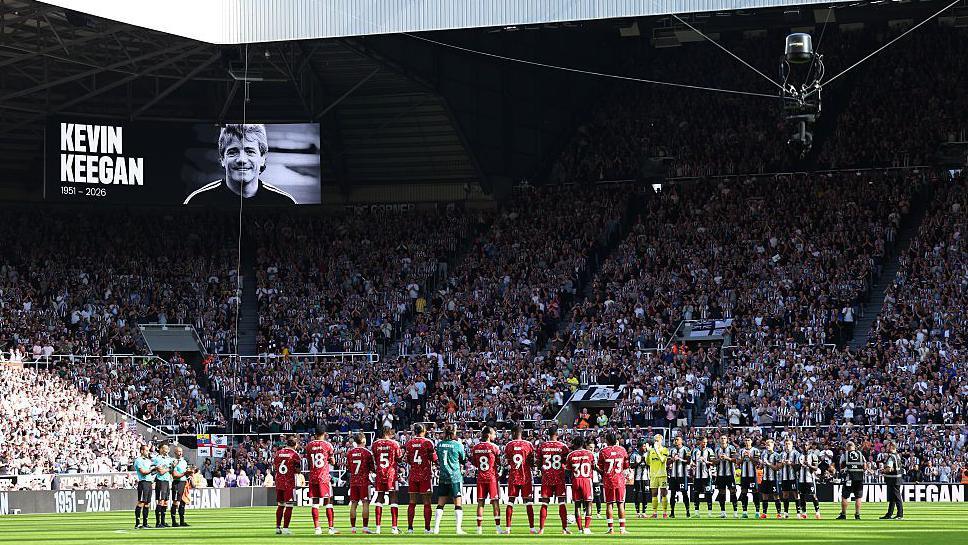
Keegan’s death after illness brought to a close a life lived largely in the public eye. The response at St James’ Park suggested that the affection he generated has outlasted the final whistle of his final match. For Liverpool he remains the gleaming product of Shankly’s judgement. For Newcastle he remains King Kev, the player and manager who understood the scale of the club’s longing. For one afternoon those identities did not compete; they stood side by side in silence, then in applause, before the more familiar business of points and positions resumed.