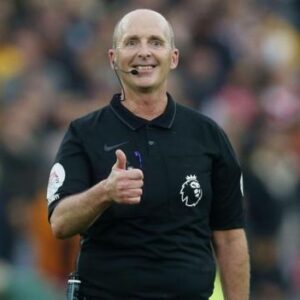
Refereeing Chiefs Question Mike Dean’s ‘Minigames’ Claims as Fans Demand Answers

Former Premier League referee Mike Dean has come under intense scrutiny after revealing that he allegedly played personal “minigames” while officiating matches, including challenging himself to go for as long as 25 minutes without blowing his whistle.
Dean, 58, brought his refereeing career to an end in 2023 after more than two decades working at the highest level of English football. Since stepping away from active officiating, he has become a familiar television and media figure, regularly discussing refereeing decisions and his experiences during his time on the pitch.
However, comments made during an appearance on Jamie Vardy’s podcast have now attracted considerable attention from supporters and people within the refereeing world.
Speaking on the Having a Party podcast, Dean explained that he and other officials would sometimes create informal challenges for their own amusement during matches. One of those challenges involved seeing how long he could allow a game to continue without blowing his whistle.
“There used to be games we would have for a laugh,” Dean said. “It would kick off, right, and we’d see how long we could go without blowing a whistle. I did that a few times in the Premier League, before VAR, obviously. I went 20, 25 minutes without blowing the whistle.”
Dean then revealed another personal challenge that he claimed to have attempted while refereeing in the Premier League. On some occasions, he would deliberately remain close to the centre circle and see how long he could avoid moving away from it.
“I used to do another one in the Premier League,” he explained. “I used to stand in the centre circle and see how long I could stay in the centre circle before I had to leave. That was just me joking about. I got about 15 minutes once, in one game.”
Although Dean appeared to describe the behaviour as harmless fun, his comments have caused concern among sections of the refereeing community. Senior figures have reportedly questioned the credibility and context of the claims, particularly because Dean did not specify when these incidents allegedly happened.
His comments also referred specifically to the period before the introduction of VAR in the Premier League during the 2019-20 season. That means the incidents, if they occurred, would have taken place under previous refereeing leadership.
Current senior refereeing officials have reportedly stressed that integrity and impartiality are fundamental principles in professional officiating. The suggestion that a referee could deliberately manipulate his approach to a match simply for entertainment has therefore prompted questions about the standards expected from officials.
The controversy has also spread beyond refereeing circles, with former Aston Villa striker Gabriel Agbonlahor strongly criticising Dean’s comments during an appearance on talkSPORT.
Agbonlahor argued that Dean appeared to be attempting to make the story sound amusing when, in his view, the nature of the claims made them anything but funny.
“He’s trying to be funny but it’s not funny,” Agbonlahor said. “You’re not funny, Mike Dean, that sums you up.”
The former striker was particularly frustrated by the fact that Dean had officiated many matches involving him during his playing career.
Agbonlahor questioned whether a Premier League referee should be treating matches as an opportunity for personal amusement, particularly given the enormous responsibility attached to officiating games at the highest level.
He also suggested that Dean’s comments could damage the public perception of referees, at a time when officials already face considerable criticism from players, managers and supporters.
Fans have similarly reacted with anger across social media. Some supporters argued that deliberately choosing not to intervene in situations that might ordinarily require a whistle could potentially influence the flow of a match.
One supporter questioned why Dean would openly discuss such behaviour after retirement, arguing that professional referees are paid to make impartial decisions rather than entertain themselves with challenges during matches.
The criticism has been especially strong because football supporters already have concerns about refereeing consistency and decision-making. For some fans, the idea that an official might deliberately test how long a match could continue without a whistle only adds to existing mistrust.
Dean attempted to provide further context about his personality as a referee, acknowledging that he sometimes enjoyed being heavily involved in the action.
He admitted that there could be an element of wanting to become more of a “centre of attention” than an official perhaps should be.
According to Dean, successfully playing an advantage could be particularly satisfying. If an official allows play to continue and the attacking team subsequently scores, he said he would feel a sense of enjoyment and achievement.
“It’s about wanting to be more a part of the game than what I should have been,” Dean explained. “If you play an advantage and it works off, you do celebrate it. If you get a decision right, you kind of want to celebrate.”
He added that he would sometimes celebrate those moments with colleagues communicating through their earpieces.
“I’d celebrate with the lads in my earpieces and stuff. If you play an advantage and somebody scores, I think it’s great. Love it.”
Despite Dean presenting these experiences as part of his personality and sense of humour, many supporters were left unconvinced.
The comments were particularly surprising to some because Dean spent years operating in one of the most scrutinised refereeing environments in world football. Every decision can affect the result of a match, the fortunes of clubs and, in some cases, the careers of players and managers.
One prominent football account on X criticised Dean’s attitude, arguing that officiating matches correctly should have been the priority rather than attempting to create personal challenges.
The account also pointed to previous comments from other high-profile referees, including Mark Clattenburg, about allowing teams to make mistakes or “self-destruct” during matches. Critics argued that such statements can create the impression that referees view themselves as characters within the spectacle rather than neutral officials whose role is to remain as unobtrusive as possible.
Another supporter sarcastically described Dean as a “professional” referee and argued that his behaviour would be more understandable in an amateur Sunday league environment than in the Premier League.
Others criticised what they saw as Dean’s tendency to behave as though he was more important than the football being played around him.
A separate fan offered a much simpler criticism: instead of setting personal challenges, referees should concentrate entirely on making the correct decisions and managing the match effectively.
The strongest reaction came from supporters who interpreted Dean’s comments as potentially suggesting that he deliberately altered the normal flow of games. One fan went as far as describing the behaviour as “corruption”, arguing that intentionally deciding when not to blow the whistle could, in theory, affect the development of a match.
There is currently no indication that Dean deliberately attempted to manipulate the final result of any Premier League fixture, and refereeing officials have reportedly questioned the context surrounding his claims rather than confirming any wrongdoing.
Nevertheless, his remarks have opened a fresh debate about the responsibilities of match officials and the way referees view their role.
For Dean, the comments may have been intended as an amusing insight into the lighter side of professional refereeing. For many supporters, however, the story has raised uncomfortable questions about professionalism, impartiality and the enormous influence referees have over Premier League matches.
More than two decades after beginning his career at the top level, Dean now finds himself facing criticism not for a controversial decision made during a match, but for revealing how he approached certain moments while he was responsible for officiating them.