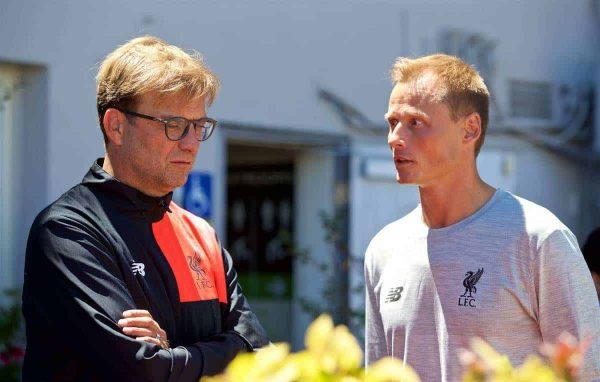
Just days before the tragic accident that claimed his life, Alex Manninger gave what would unknowingly become his final interview—a heartfelt reflection on a career that spanned continents, trophies, and unforgettable moments. In that conversation, he spoke with warmth and honesty about his journey through football, particularly his cherished time at Arsenal F.C. and Liverpool F.C., offering a glimpse into both his professional pride and personal regrets.
Only a short time later, the football world was shaken by the devastating news that Manninger had died at the age of 48 after his car was struck by a train at an unguarded level crossing in Nussdorf am Haunsberg, Austria. The suddenness of the incident cast a somber shadow over his recent words, turning what had been a nostalgic look back into a poignant farewell.
In the interview, Manninger appeared relaxed and reflective, speaking from his home in Austria where he had settled into a quieter life after retiring from football in 2017. Surrounded by the countryside he loved, he discussed not only his career but also the path he had taken afterward—returning to his roots as a trained carpenter and launching a business focused on renovating traditional homes. Friends later revealed that he took immense pride in this work, often saying it gave him a sense of purpose similar to football, but without the pressure.
Yet it was clear that his years on the pitch still meant everything to him.
Recalling his move to Arsenal in 1997 under Arsene Wenger, Manninger’s voice reportedly carried a sense of wonder, as though he were reliving the moment. “I was just 20, still a kid,” he said. “To walk into a club like that—it was incredible. Everything felt bigger, faster, more intense.”
He described Wenger’s vision at the time as revolutionary, particularly the emphasis on youth and international talent. Manninger was part of that new wave, arriving from Austria with ambition but also uncertainty about how he would adapt. What helped him settle, he explained, was the presence of experienced leaders in the dressing room—none more influential than Tony Adams.
“He was like a wall in front of me,” Manninger said. “A real leader. He taught me so much—not just about defending, but about responsibility. When you have someone like that in front of you, you feel protected.”
Despite his youth, Manninger quickly demonstrated composure beyond his years. He spoke about how he rarely felt overwhelmed, even in high-pressure matches. Instead, he approached each game with a calm focus, something he believed was key to his success during Arsenal’s famous 1997/98 season.
That campaign, which ended in a historic domestic double, remains one of the defining chapters of his career. Manninger played a crucial role during a critical stretch when the team was chasing both the Premier League and FA Cup. In the interview, he modestly downplayed his contribution, but those who watched him knew how vital he had been.
Still, there was one lingering regret.

“I didn’t want to leave,” he admitted. “That’s the truth. But I needed to play more. At that age, you don’t want to sit on the bench—you want to be out there, learning, improving.”
His departure from Arsenal marked the beginning of a long journey across European football. Manninger went on to represent clubs such as ACF Fiorentina, Torino F.C., Bologna F.C., Siena, and Juventus F.C., as well as spells in Germany and a return to Austria.
He spoke fondly of his time in Italy, describing it as a period that refined his tactical understanding of the game. “Football there is different,” he explained. “It’s more about positioning, anticipation. You learn to think differently as a goalkeeper.”
Across his career, Manninger made more than 300 appearances, building a reputation as a reliable and intelligent presence between the posts. Yet when reflecting on his final chapter in football, it was his move to Liverpool that brought a particularly emotional response.
Joining the club in 2016 at the age of 40, Manninger knew he would not be a regular starter. Instead, he embraced a supporting role behind Simon Mignolet, offering experience and mentorship within the squad. Despite not making a competitive appearance, he described the experience as deeply meaningful.
“It was the perfect way to say goodbye,” he said.
He recalled how the move came about through a direct phone call from Jurgen Klopp, who remembered Manninger’s standout performance against his Borussia Dortmund side years earlier.
“He told me, ‘I want that goalkeeper—the one who saved everything against us,’” Manninger said with a smile. “That meant a lot to me.”
One of the most vivid memories he shared was his farewell moment at Anfield, standing in front of the Kop. Even without having played a competitive match, he felt embraced by the supporters.

“To say goodbye there, in front of those fans—it was special,” he reflected. “You don’t forget something like that.”
Those close to Manninger later said that interview captured him perfectly: thoughtful, grounded, and quietly proud of his journey. He did not dwell on fame or accolades, but rather on experiences, relationships, and personal growth.
In the days following his death, tributes poured in from across the football world. Red Bull Salzburg expressed deep sorrow, remembering him as one of their own. Juventus F.C. highlighted not just his abilities as a player, but his humility and professionalism—qualities that defined him throughout his career.
Friends and former teammates have also shared stories that echo the sentiments of his final interview: a man who valued simplicity, who found joy in quiet moments, and who remained connected to the game without being consumed by it.
In hindsight, that last conversation now feels like more than just a reflection—it reads as a closing chapter. Manninger spoke with gratitude, acknowledging both the highs and the sacrifices that shaped his career. He had found peace in life after football, building something meaningful away from the spotlight.
His passing has left a deep void, but his words endure—offering a lasting reminder of a player who may not always have sought attention, yet earned admiration wherever he went.
For those who listened to that final interview, it is impossible not to feel the weight of what has been lost. But it also serves as a tribute in itself: a sincere, unfiltered account of a life lived with purpose, both on the pitch and beyond it.